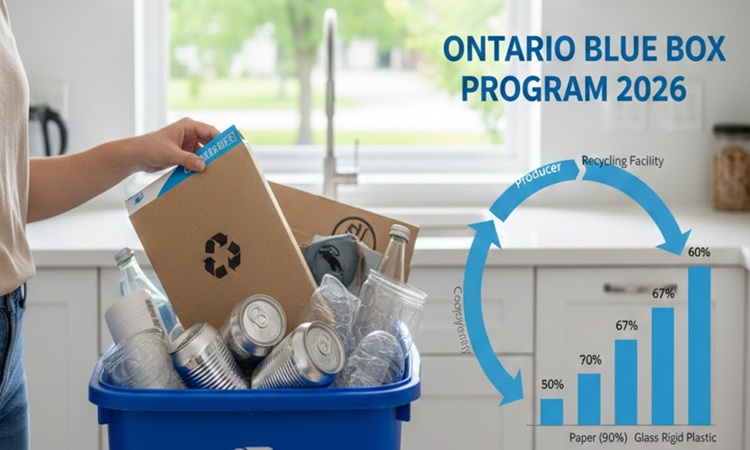
A previous article on this transition of the Blue Box Program to an Extended Producer Responsibility (EPR) framework, (effective January 1, 2026), referred to the new items that can be collected and an overview of Circular Materials, the organization coordinating the producers.
This article:
- outlines several operational, environmental, and financial benefits for Richmond Hill. (The Staff Reports and Council Approval are at the end of this article).
- presents possible shifts in packaging.
Operational and Resident Benefits
Province-Wide Standardization: The program will establish a common recycling system across Ontario with a standardized list of acceptable materials, ensuring consistency regardless of where residents live1.
Expanded Material List: The transition will expand the variety of materials that are accepted for recycling.
Enhanced Education Tools: Residents will have access to a province-wide promotion and education program, including a dedicated recycling app, guides, and municipality-specific webpages.
Financial Benefits for the City
Cost Shift to Producers: Producers will become 100% financially and operationally responsible for the collection and management of recyclable products and packaging. Currently, producers only cover 50% of these cost
Overall Cost Avoidance: The transition represents a net annual budget impact of $107,000 in cost avoidance for Richmond Hill.
Specific Savings Breakdown: The removal of residential recycling from the City's waste contract provides a subtotal cost avoidance of $800,000.
An additional $13,000 is saved by no longer offering free blue box exchanges.
Administrative and Strategic Benefits
Reduced Administrative Burden: The City will no longer be responsible for managing blue box-related complaints, missed collections, or requests for replacement boxes.
Strategic Alignment: The program aligns with the City’s Strategic Plan to "Grow a Livable Sustainable Community" by making decisions that protect the needs of future generations.
Specific diversion targets and their potential impacts on consumers, based on the requirements of Ontario Regulation 391/21.
Mandatory Diversion Targets and Consumer Impact
The new Blue Box Program includes strict Recovery Targets (also known as diversion targets), which require producers to ensure a specific percentage of the materials they supply are successfully collected and recycled.
Specific Diversion Targets (2026–2030)
Producers must meet minimum recovery percentages for different material categories. While recent provincial amendments have introduced a "best efforts" period for 2026–2027 to allow the system to stabilize, the long-term mandatory targets remain high:
- Paper: 90% recovery target.
- Beverage Containers: 75% recovery target.
- Glass: 67% recovery target.
- Metal: 67% recovery target.
- Rigid Plastic: 60% recovery target.
- Flexible Plastic: Starting at 10%, with requirements to scale up significantly by 2030.
What could this mean for the consumer?
Indirect Price Increases: Since producers are now 100% financially responsible for the recycling system (up from 50%), they may choose to pass these operational costs on to consumers through slightly higher prices for packaged goods.
Consumers are likely to see several shifts in how products are packaged as producers try to meet these high targets and minimize their own costs:
Design for Recyclability: Producers pay higher fees for materials that are difficult to recycle. This incentivizes them to switch from multi-layer laminates or "mixed" materials to simpler, 100% recyclable options (e.g., switching from a plastic-lined paper bag to a pure paper or pure plastic one).
Reduction in "Over-Packaging": To lower their total tonnage and associated fees, companies are expected to reduce unnecessary secondary packaging (like boxes around plastic tubes or excessive plastic wrap).
Standardized Materials: Because the list of accepted materials is now the same across all of Ontario, manufacturers are more likely to use materials that are universally accepted in the Blue Box, making it clearer for consumers what goes in which bin.
Innovative Materials: You may see an increase in certified compostable packaging or highly specialized lightweight plastics that are designed to meet the province’s new environmental standards.
Council Approves New Waste Collection Contract for Richmond Hill - City of Richmond Hill